
Why IT projects get out of hand ...
... and what you can do about it!
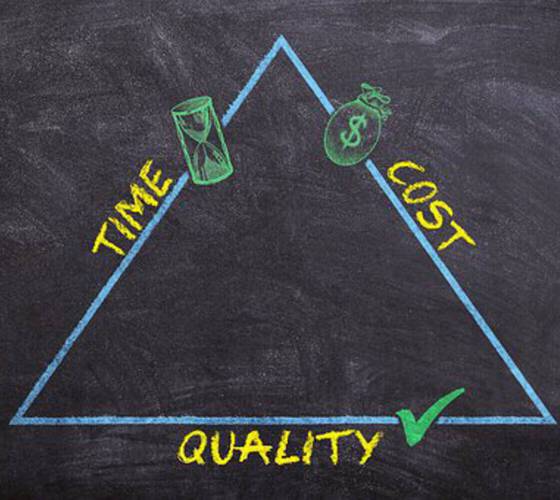
Alarmingly often projects go beyond the cost and time frame or simply fail. Very few IT projects are completed successfully. Why and what can you do about it?
Facts and figures
According to a study by the TU Munich, less than half of the IT projects of the last years were successful. The projects lasted longer than planned, cost considerably more or did not lead to the planned result. Other projects had to be abandoned wasting a lot of money. Most other studies come to similar conclusions.
According to a study by GPM (German Association for Project Management Deutsche Gesellschaft für Projektmanagement e.V.), communication, goal definition and employee qualifications determine the success of a project.
Goals, resources and communication
- You need a precise objective. Are the goals set realistic?
Definition of goals - What is expected in the end? - Make sure that those involved in the project have the necessary expertise and sufficient time to implement it. Practice shows how important buffer times are.
Time management! - Changes often take place without sufficient coordination and clear definition of goals.
Communication
How to communicate successfully:
- Pay attention to linguistic accuracy
- Ask immediately if something is unclear
- Document and publish the clarification
Acceptance processes are also part of the communication. Describe acceptance scenarios in detail: What criteria must be fulfilled for acceptance to take place? How is the acceptance documented?
E-mail and/or telephone?
It's often easier to write an e-mail. However, when it comes to clarifying things, the best alternative is to pick up the phone. Preferably followed by a compact summarizing e-mail.
How to deal with changed requirements?
A critical point: Have requirements changed in the course of the project or have they not been sufficiently described (see above)? Is it necessary to change the project plan, with all the consequences in terms of time, costs and communication?
Subsequent changes are often due to misunderstandings. They often lead to a protraction of the project. Follow-up projects are often the best way to avoid long-term projects!
If an adjustment of the project plan becomes necessary, this must absolutely be documented. It must be comprehensible why the original schedule was abandoned. A change of the project without coordination, communication and documentation is in no case acceptable. It has proved successful to carry out an assessment after each phase resulting either in the release of the next phase or in a reorientation of the project. These intermediate steps are a great help, especially in larger projects.
The human factor
In many cases, the departments which will work with the solution are not sufficiently involved. It is better to get everyone on board at an early stage. Inform the employees comprehensively and listen to them when they express concerns. Persuade them and reduce resistance. It is always more economical to invest time in advance than to risk the project being protracted or even boycotted.
A project means work
Work consisting of planning, organization, communication, control and adaptation. These things cost time and money and have to be considered in the budget. If project management is not given the importance it needs, failure is inevitable. This is always the most expensive solution, because not only money, but also valuable time is wasted. Efficient project management is not a "nice-to-have", but an absolute must.
Conclusion
Every project needs project management and good craftsmanship. These are the basics. And for every project you need SMART goals: Specific, Measurable, Accepted, Realistic and Scheduled. If you then make sure that there are sufficient resources, that goals and standards are defined, that the team members are qualified and communicate well, you have the very best chances for success.